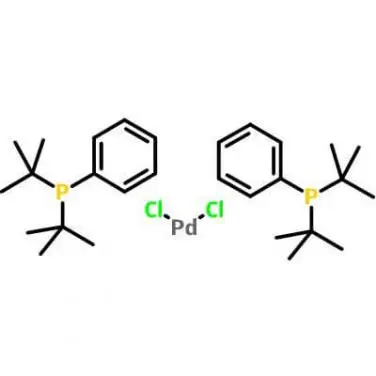
dichlorobis(di-tert-butylphenylphosphine)palladium(II)
| Identification | ||
| Name | dichlorobis(di-tert-butylphenylphosphine)palladium(II) | |
| Synonyms | PdCl2[P(t-Bu)2Ph]2; dichlorobis(phenyldi-tert-butylphosphine)palladium; trans-Dichlorobis(di-tert-butylphenylphosphine)palladium(II); palladium(II)bis(di-tert-butylphenylphosphine) dichloride; bis[di-tert-butyl(phenyl)phosphane]dichloropalladium; bis[(di-tert-butylphenylphosphine)]palladium dichloride; Dichlorobis(di-tert-butylphenylphosphine)palladiuM(II),Pd; |
|
| Molecular Structure |  |
|
| Molecular Formula | C28H46Cl2P2Pd | |
| Molecular Weight | 621.94 | |
| CAS Registry Number | 34409-44-4 | |
| Properties | ||
| Pd content | 17% up | |
| Appearance | Yellow powder | |
| Melting point | 260-264°C | |
| Safety Data | ||
| Safety Description | S36/37/39 | |
dichlorobis(di-tert-butylphenylphosphine)palladium(II) Application:
Bis(di-tert-butylphenylphosphine) palladium(II) dichloride is mainly used as a catalyst in coupling reactions and used in coupling reactions such as Suzuki, Kumada, and Negishi.